Likes Ain't Cash - Why your engagement numbers are lying to you
A little while back I was chatting to a host in Oxford and she showed me her phone with genuine pride. "Look at this," she said, scrolling through post after post. Fifty-plus likes on each one. Consistent engagement. Beautiful photography. She'd been posting for the better part of a year and on the surface the numbers looked healthy.
"How many link clicks did your last post drive?" I asked.
Silence.
Not the awkward kind. The kind that means she'd never looked. Because the Insta-Gurus she followed had never suggested she should.
"But I'm getting fifty likes a post," she said. "My reach is excellent."
It means fifty people tapped a heart icon and kept scrolling. It means the platform handed her a dopamine hit and called it progress. It means her content was giving her likes on a silver platter and whispering "you're doing great" while her booking page sat lonelier than a pub at 9am on a Sunday.
Likes ain't cash.
If you've been posting for months and still can't tell me which post drove the most profile visits or external link clicks, you're her. And you're not alone. I spent years in that same space, posting and hoping, celebrating the wrong numbers, and not knowing if any of it translated into actual paying guests.
Not your fault. Nobody told you what to measure. Nobody told you that posting without measurement is posting blind.
You were told you needed to be on Instagram. You tried. You posted and you Reeled and you grabbed every secret formula and viral hack you could find. Nothing stuck. Now the fear gently hums in the background. You know you should be posting. But it takes so much time... "and for what?" you rightly ask. You might even dread opening the app.
Maybe you're now thinking: "I just don't know what's working. Or what's not, for that matter. Is it even working? I've not recorded any data. It's too late to start. Posts from a year ago will have outperformed anything I posted last week. How do I compare apples to apples?"
It's stressful, I know. So don't worry about what's already behind you. Ignore the old apples and start today. Twenty-four hours after every post goes live, you record no more than nine numbers. This takes a little discipline to begin with but soon becomes a habit. By this time next month you have 4 weeks of clean data. By this time next year you have a dataset that tells you exactly what works... and what doesn't.
The posts without measurement history can't help you now. Every post from today forward can.
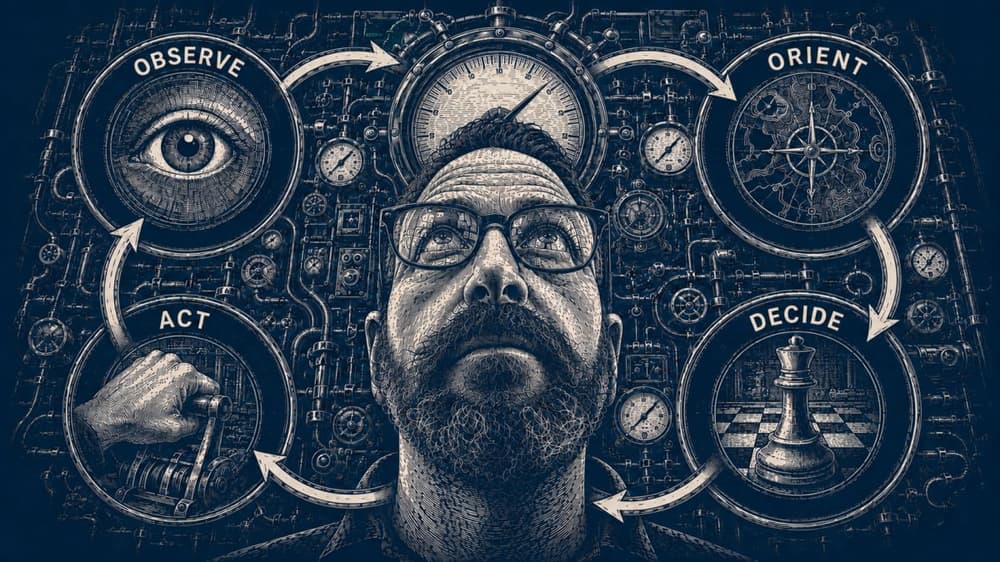
There's a mechanism that moves you from the reactive chaos of ad hoc posting to calm controlled marketing. I learned it in the dead of night at RAF College Cranwell.
OODA stands for:
Observe
Orient
Decide
Act.
It's the command structure the British military uses for dynamic live operations: moving terrain, shifting threats.
“No plan survives first contact.”
You run the loop constantly instead of relying on a static briefing.
Social media is the same kind of environment: your audience shifts; the platform rewrites its rules; what worked six months ago goes stale; what worked yesterday might not work tomorrow.
Posting without a feedback loop is navigating unfamiliar terrain in the dark with no map and no compass. You might get somewhere. You probably won't even know when you arrive. You're posting blind.
Here's how the loop works for your content.
Observe:
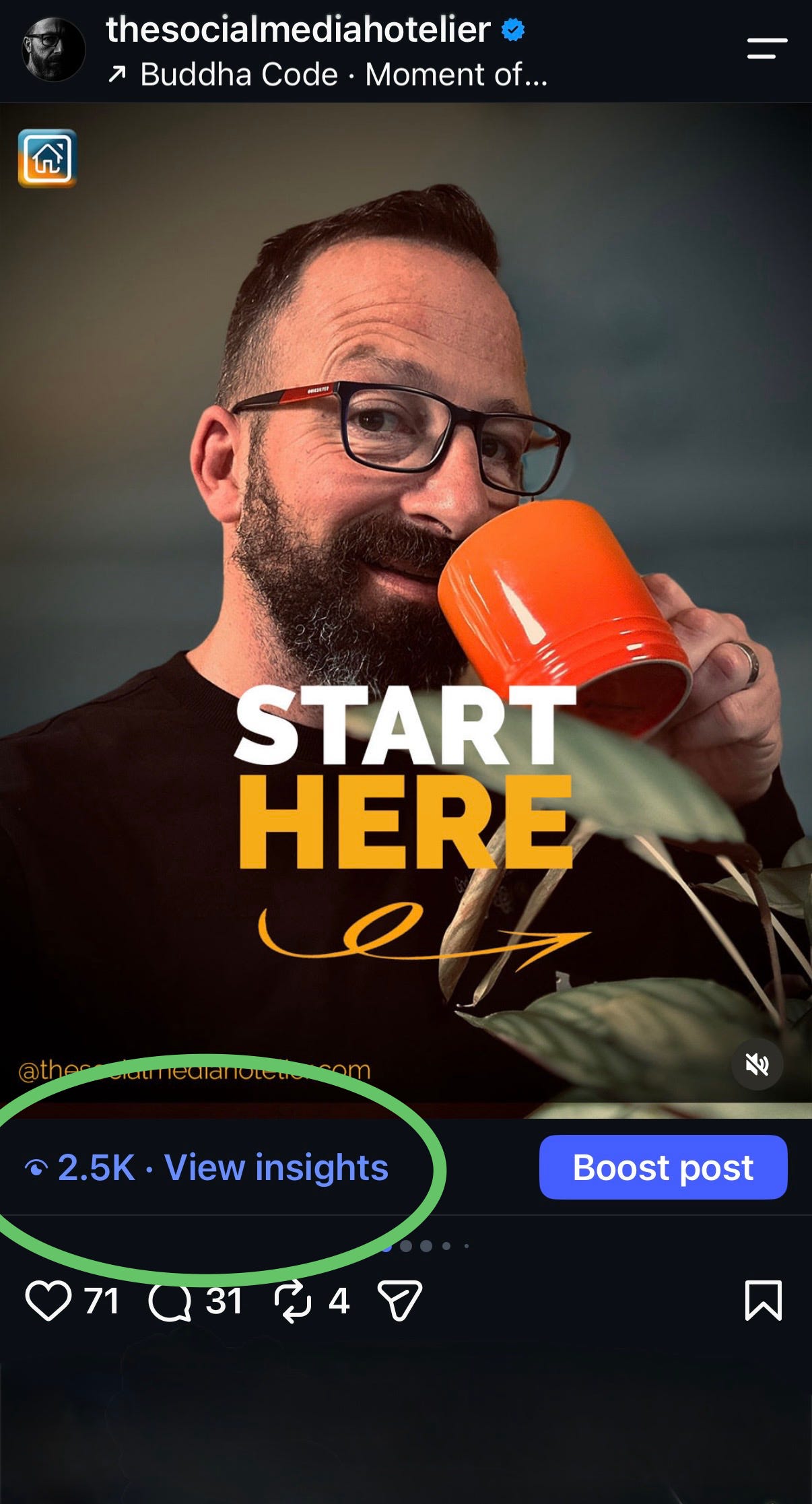
Twenty-four hours after every post, tap that blue View Insights button and record the numbers.
If you're in Europe, you get seven: Reach, Likes, Comments, Saves, Profile Visits, Follows, and Link Clicks.
If you're in North America, you get two more: Shares and Reshares.

Seven numbers. Nine if you are in the States. Record them in a spreadsheet or a notebook. Post by post, week by week. It takes a couple of minutes and a little discipline.
Within months you have something most hosts never build: a dataset that tells you what your content is actually doing.
Orient:
After a few months of recording, you have enough data to see the shape of things.
Now you ask: what am I optimising for? More Reach because your funnel is dry and you need new eyes? More Follows because you want account growth? More Link Clicks because you want conversions to your booking page?
Pick the metric that matters for whichever chapter of your marketing you're in. Sort your content by that metric. Suddenly the fog clears. You can see which posts pulled their weight and which just looked pretty.
This is the moment most hosts never reach. They stay stuck in "what should I post next?" instead of "what did my data tell me?" Without orientation, you blindly end up somewhere you never intended.
During one of our night exercises at Cranwell, I was put in command of a flight. Our task: move across unfamiliar terrain in the dark and secure a landing site. The tactical execution was flawless. We moved silently. We covered each other properly. We established a defensive perimeter. Then the sun came up and the morning mist cleared. I looked around to admire the flawless perimeter defences, only to discover we had aggressively, brilliantly, and with maximum precision set ourselves up in a local farmer's asparagus field.
The tactics were beautiful. The navigation was a total disaster. We had ignored Orientation.
Instagram presents the same problem. You can post beautifully, consistently, get engagement, and still be in completely the wrong place. Orientation is what prevents that.
Observation tells you where you are and Orientation shows you where you're going.
Decide:
You sort your data for the metric you want to chase down. The top third of those posts will clearly outperform the rest for your chosen metric. The bottom third won't. The middle third is average: not bad, not exceptional.
Now your decisions aren't creative. They're mechanical. They're data-driven.
Top thirty-three percent: carbon copy. Same core hook. Same structure. Same value angle. Maybe adjust the wording slightly. Perhaps try swapping the cover image. These posts already proved themselves. If they worked once, they have a high probability of working again.
Bottom thirty-three percent: discard. They're not failures. Every post is data. But they're not what you want to be doubling down on.
Middle thirty-three percent: study. Pull them up alongside your top performers. What did the top posts do that the middle ones did not? A stronger hook? A clearer CTA? Different format? Take notes. Then experiment using the top third as your guide.
Act:
This is where the loop becomes productive. You're no longer posting and hoping. You're posting purposefully, using evidence you built yourself.
Carbon copies go out first: proven concepts, repackaged. Then your experiments from the middle third, informed by what your top performers taught you. A poor post isn't a failure. It's a learning opportunity. You don't lose. You win or you learn.
Repeated messaging is not a mistake. It's essential for effective marketing. I ran this experiment myself:
January 2022, I posted about Parson's Pleasure, the naked bathing spot on the River Cherwell. Forty-two likes. Five comments. Zero saves.
A year later, I carbon-copied it: same hook, same structure, different day. Forty-three likes. Twenty-two comments. Two saves. The likes barely moved. The conversation quadrupled. The data had told me the concept worked. All I did was give it more surface area.
And then you return to Observe. The loop never closes. Record regularly. Check for outliers each month. Review it thoroughly every quarter. The loop permanently replaces the question that has haunted you since your first post: "what should I post next?" The question becomes "what did the last 3 months teach me?"
Dina Harania posted three times a week. She recorded her content performance for a full year in a simple content calendar. Every post. Every metric. Twelve months of data.
When the year was up, she sorted her entire library by the metric she wanted to improve. She carbon-copied the top third. Discarded the bottom third. Studied the middle third against her best performers to understand what to tweak.
Three months. Fifteen thousand pounds in shoulder-season bookings tracked from Instagram. Three posts a week. Roughly one third of her content was carbon-copied from the previous year. That portion of repeat content continues to grow.
No new creativity required. Just recognising what already earned trust, appreciating that there is no need to reinvent the wheel and doing it again.
This is the loop. I built the 10-80-10 Protocol to run it at scale. But you don't need the protocol to start. Record your numbers twenty-four hours after your next post. By this time next month you have a dataset. By this time next year you have a system that tells you exactly what to do next.
That Oxford host is still posting. She still gets her fifty likes. But she still doesn't know if any of it moves anyone towards making a booking. You don't have to be her.
Most hosts treat Instagram like a creative lottery. The OODA loop turns it into a tuneable system… and systems only work when you stay in the loop.