How I Led Eight People Into An Asparagus Field
A few months ago, I led 8 trainee RAF Officers into an asparagus field.
Not metaphorically. Into an actual asparagus field. In the dark. In the rain. In full combat gear. Which, in fairness, is not where the Royal Air Force usually hopes its soon-to-be commissioned officers will end up.
It was on a night exercise at RAFC Cranwell. I was in command. Our task was straightforward: move across unfamiliar terrain, stay within the training area, secure a landing site, and avoid private farmland.
We were cold, tired, wet, and operating on very little sleep. I needed a quick win to get my troops dry and rested, so I made my assessment, gave the order, and moved the team out.
Tactically, we were exceptional. We moved silently. We covered each other properly. We reached the destination quickly. We established an overlapping defensive perimeter. If you’d judged us only on movement, communication, and execution... we looked like seasoned pros.
Then the sun came up and the morning mist cleared. I looked around to admire the flawless perimeter defences… and discovered that we’d aggressively, brilliantly, and with maximum precision set ourselves up in a local farmer’s asparagus field.
Nine armed military personnel. Crouched in the mud. Neat little rows of vegetables. A dog walker stared at us. I slowly slung my weapon, looked her in the eye, and said what only an RAF Officer would: “Morning. Would you like a cuppa?”
The disappointing thing was that we hadn’t failed because we were lazy. We hadn’t failed because we lacked effort. We hadn’t failed because we’d failed to act decisively. I’d failed because we’d executed perfectly… just in the wrong direction.
My Commanding Officer later reminded me of a line I’ve always loved and still plays on my mind: “Strategy without tactics is the slowest route to victory. Tactics without strategy is the noise before defeat.”
The Marketing Looks Better. It’s Not Working Better.
It’s been a while since I last published anything here. Not by design.
Over the last few months, one thing has taken most of my attention. After nine years of enlisted service, I earned a Royal Commission in the Royal Air Force. As of 28 May, I’m a Flying Officer.
The training was harder than I expected, and I’m still slightly surprised my knees survived. I spent my 49th birthday sitting in a ditch. The crew got me a cake and a party hat, so morale was maintained.
A few days after commissioning, I spoke at the SCALE with AI conference in Brighton. Sitting in that ditch gave me plenty of time to think. About AI. About marketing. About business. About what actually matters.
One thing I realised during all of this is how much I’ve missed writing and contributing to the community. And one thing I saw with alarming clarity is this: AI increased speed. It did not improve strategy.
Hosts and property managers are posting more, writing more, automating more, and using AI more. The output is looking more polished than ever. Captions are smoother. Emails are cleaner. Listing descriptions are tighter. Review replies sound more professional.
More output. More polish. More automation. Still not marketing.
My Commanding Officer’s verdict applies here, too. Swift, flawless execution aimed at the wrong target isn’t success. It’s a journey into an asparagus field.
If the strategy is weak, AI doesn’t fix it. It amplifies it. Efficiency without intent is a liability.
4 years ago hosts and property managers were handed weapons of mass execution. AI can execute more captions. More graphics. More listing copy. More emails. But execution isn’t command, it isn’t judgement, and it isn’t taste. It’s just “get it done.”
The result is AI-assisted marketing that sounds like it was written by a committee of well-meaning interns who’ve never hosted a guest. Polished, fluent, and instantly forgettable.
It’s not badly written. It’s badly briefed.
This was the central idea behind my talk in Brighton: AI isn’t responsible for the onslaught of beige, bland marketing we’re all bemoaning. It has just exposed who was never actually marketing in the first place.
Posting content isn’t marketing.
Sending emails isn’t marketing.
Publishing blogs isn’t marketing.
Those are execution results. Useful? Sometimes... but only after the important decisions have already been made.
The Beanie Isn’t The Point. Recognition Is.
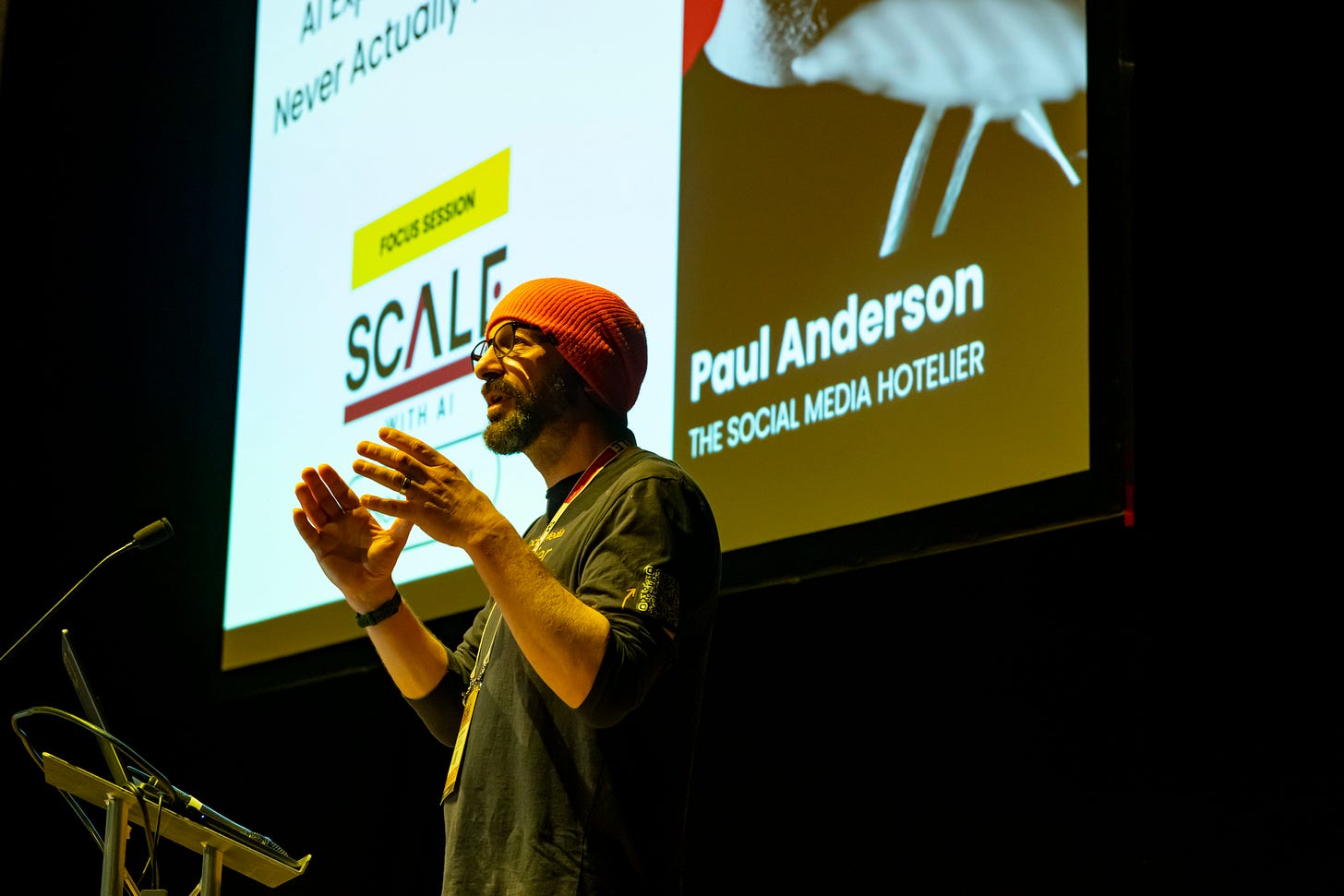
When I stepped onto the SCALE with AI stage in Brighton I naturally wore my trademark orange beanie.
When I say it out loud, this sounds faintly ridiculous. There I was, asking people to take AI, marketing, Me, and the future of our industry seriously... whilst dressed like somebody who’d taken a wrong turn on the way to some roadworks.
My mum thinks it makes me look as though I’m “about to dig up the driveway”... she’s not wrong. It is a hi-vis look.
The funny thing is, I never bought the hat for branding purposes.
I first bought it after we briefly lost sight of our first-born in a crowd. I wanted… no, needed… to be the easiest person for him to find. That was it. No grand strategy. No personal brand consultant. No colour psychology. Just a Dad trying to make himself easier to spot in a crowd.
Over time, the hat started appearing elsewhere. I wore it presenting a Bootcamp when I had COVID. I wore it teaching at a summit when the central heating had failed in the dead of winter. Eventually, something unexpected happened. People started expecting to see it.
The first time I appeared without it, my DMs blew up:
“Where’s the beanie?”
“Why aren’t you wearing the beanie?”
“BRING BACK THE BEANIE!”
That was the moment it dawned on me. The market had claimed the signal. Y’all had given me my trademark.
The goal isn’t perfection. The goal isn’t polish. The goal is to stand out and be recognised. More than that, it is to be recognised FOR something. The hat isn’t distinguished. Yet it distinguishes me. If I want to disappear into a conference crowd, I take it off. When I need to step into the version of me that teaches, leads, is comfortable in my authority, and owns my space... I put it back on.
Right now, short-term rental marketing is fast becoming a sea of sameness. Polish is now almost free and, as a commodity, it’s lost its value as a signal. Texture... the unmistakable mark of an operator who showed up and did the strategic work... is the new high-value currency.
The hosts who win in this marketing renaissance won’t be the loudest or the most prolific. They’ll be the ones who did the awkward, unglamorous work of defining who they’re actually talking to, then used AI as a Digital Second in Command (2IC) rather than a replacement for thinking.
That’s the 10-80-10 Protocol.
10% Commander’s Intent: the human defines the guest, the strategy, and the guardrails.
80% Supported Execution: AI drafts, formats, and does the heavy lifting.
10% Command Inspection: the human injects texture and taste, rejects beige, and exercises judgement... they put their orange beanie on it.
Most hosts are trying to do the 80% without ever completing the first 10%. They’re executing beautifully. Straight into the asparagus.
The Work That Has To Happen Before You Write A Single Word
I want to talk about the first 10% in detail, because it’s absolutely fundamental to everything that follows. Skip this part, and your AI has no option but to guess. Sometimes the guess sounds plausible... but it’s still a guess.
Your Perfect Potential Guest Isn’t A Demographic
Most hosts and property managers are still working with labels gathered from past bookings: “Multi-Generational Families.” “Retired Couples.” “Business travellers.” “Dog owners.”
Those are categories. They’re not strategic targets.
Real marketing starts when you move beyond demographics and into psychographics. Not just who they are. What is happening in their mind before and as they book.
A potential guest doesn’t just wake up and say “I think I’m gonna book me some accommodation today.” At least, I hope not. They’re trying to solve something.
A family might be trying to avoid another holiday where nobody sleeps properly and everyone comes home needing another holiday.
A couple might want somewhere that feels special without feeling stiff and formal.
A group organiser might be trying to avoid being treated like a walking damage deposit.
A business traveller might be trying to feel human at the end of a long day, rather than wedged into another blank box near a ring road.
None of those are demographic groups with age ranges or genders. They’re buying dynamics. And AI can’t work with them unless you put them into the brief.
This is where the PPG Profiling Partner earns its keep. I built it from the transcripts of more than 350 hours of one-to-one coaching calls, digital training material, and group coaching sessions with hosts and property managers. It asks the questions that extract the psychographic detail AI needs before it can produce anything useful. The thinking before the writing. The Commander’s Intent before the execution.
But there’s a trap most hosts fall into before they even get to the PPG. They’ve been told to post every day, use the right format, decode whatever the algorithm wants this week. They’re serving an invisible master instead of a visible guest. Exhausting. Familiar. And it never works.
The breakthrough comes when you stop asking “What do the algorithms want?” and start asking “What do my Perfect Potential Guests need?”
❌ I hope this post serves the algorithms
✅ I hope this post serves my Perfect Potential Guests
❌ Will the algorithms value this?
✅ Will my Perfect Potential Guests value this?
When you consistently create content your ideal guests actually value, the algorithms notice. They think: “These types of people engage with this content. Show it to more people just like them.”
The algorithms become your distribution partners, not something to beat.
Instagram isn’t about impressing invisible algorithms. It’s about building trust with visible humans who have credit cards and holiday budgets.
Map The Steps. Find The Friction.
Once you know who you’re talking to, the next step is to map the steps they’re trying to move through and the problems that may stop them choosing you. This is Step-Problem Analysis, and it’s where everything gets practical.
The family worrying about whether the sleeping arrangements will ruin the holiday before it begins. The couple worrying that “special” will mean “stiff and formal.” The group organiser worrying about being treated like a liability the moment they mention the group size.
These aren’t things a generic AI prompt can uncover. You have to do the work. Then, and only then, can you give the AI something real to work with.
The Brief Is The Problem
Once you’ve profiled your perfect guest and mapped their problems, you can get your AI of choice to write the brief that you then feed back to your Digital 2IC. The questions it must answer aren’t complicated, but they are specific:
Who is this actually for?
What do they need to believe before they choose us?
What are they worried about?
Why would they trust us?
What are we trying to move them towards?
What should we deliberately NOT say?
Hand that to your Digital 2IC. Give it the command structure it needs to give you the 80% (Supported Execution). The AI stops guessing and starts accelerating... in the direction you give it.
Then comes the Command Inspection. The 10% that separates the memorable from the beige. Inject texture. Reject the average. If it reads like it could have been written by anybody, it’ll reach nobody.
Efficiency without intent is a liability. AI has handed hosts weapons of mass execution. But execution isn’t command.
The question isn’t “can AI do it faster?”
The question is “should we be doing it at all?”
Stop posting and hoping.
Do the first 10%.
THEN let the machine handle the rest.